Employees vs. Contractors: What Sets Them Apart
Brad Dickfos • June 13, 2025

The Australian Taxation Office (ATO) has recently revised its guidance on differentiating between employees and independent contractors. This change follows several court rulings that clarified the criteria for determining whether a worker is genuinely an employee or an independent contractor.


Whether you’re a worker or a business owner, understanding these differences is crucial, as they have an impact on tax, superannuation, and workplace entitlements.


Why does the difference matter?

How a worker is classified – either as an employee or a contractor – impacts who is responsible for paying taxes, providing benefits like superannuation and leave, and who carries legal responsibilities. Misclassifying a worker can lead to serious financial consequences, including unpaid entitlements and penalties from the ATO.


Key differences between employees and contractors

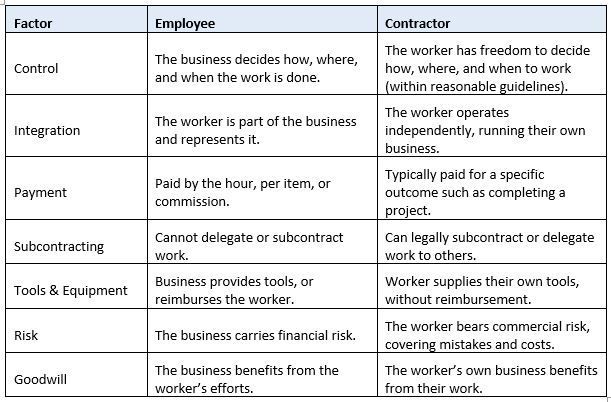
The primary difference lies in how the worker interacts with the business:

·        Employees work in the business and are part of its operations.

·        Contractors work for the business but maintain their own separate operation.

The contract between the business and the worker is crucial in determining a worker's classification. While day-to-day work practices play a role, the legal rights and responsibilities outlined in the contract hold the greatest significance.


See the table above for the ATO’s most important considerations.


Superannuation and contractors

Even if someone is considered a contractor, they might still be entitled to superannuation if:

·        They’re paid mainly for their labour.

·        They work as a sportsperson, artist, entertainer, or in a similar field.

·        They provide services for performances or media production.

·        They do domestic work for over 30 hours per week.


Workers who are always employees

Some workers are always considered employees, no matter what. This includes apprentices, trainees, labourers, and trades assistants.


Apprentices and trainees work while completing recognised training to earn a qualification, certificate, or diploma. They might be full-time, part-time, or even school-based and usually have a formal training agreement.


Most of these workers are paid under an award, meaning they have set pay rates and conditions. Businesses hiring them must follow the same tax and superannuation rules as they do for other employees.


Companies, trusts, and partnerships are always contractors

If a business hires a company, trust, or partnership (rather than a person) it’s always considered a contracting arrangement. However, people working for that entity could still be employees of that entity, rather than the business hiring the services.


Why this matters to you?

For workers, knowing your status helps ensure you receive the correct pay and benefits. For businesses, classifying workers correctly helps avoid fines and ensures compliance with tax and employment laws.


If you need more details or want to check your situation, reach out to us for more information. Proper classification today can prevent costly mistakes in the future.


By Brad Dickfos December 9, 2025
Sometimes it can be, but only in limited circumstances. The tax deductibility of expenditure on clothing is subject to strict ATO guidelines. These cover occupation-specific clothing, compulsory or registered non-compulsory uniforms and protective items. Conventional clothing What you can’t claim is the cost of conventional clothing, even where your employer expects you to observe a particular dress style. You might work in an office environment, and your employer expects you to wear a business suit to work, even though you wouldn’t have even bought the suit but for your employer’s dress requirements. While the cost of the suit might seem like a work related expense, it is not deductible as it is conventional clothing that could also be worn outside of work. This makes it a private expense, even though it relates directly to your employment. Conventional clothing includes business attire, non-monogrammed black trousers and white shirts worn by wait staff, non-protective jeans and drill shirts worn by tradies and athletic clothes and shoes worn by PE teachers. Occupation-specific clothing On the other hand, occupation-specific clothing falls on the deductible side of the line, for example a chef’s distinctive chequered pants or a health worker’s blue uniform, including nurses’ stockings and non-slip shoes. Compulsory uniforms The cost of clothing that forms part of a compulsory uniform is generally deductible. A compulsory uniform is a set of clothing that identifies you as an employee of a particular organisation. Your employer must make it compulsory to wear the uniform and have a strictly enforced workplace policy in place. You can only claim a deduction for shoes, socks and stockings if: They are an essential part of a distinctive compulsory uniform, and The characteristics (the colour, style and type) are an integral and distinctive part of your uniform that your employer specifies in the uniform policy, for example, airline cabin crew members. You can claim for a single item of clothing such as a jumper if it's distinctive and compulsory for you to wear it at work. An item of clothing is unique and distinctive if it: Has been designed and made only for the employer, and Has the employer's logo permanently attached and is not available to the public. Just wearing a jumper of a particular colour is not part of a compulsory uniform, even if your employer requires you to wear it, or you pin a badge to it. Non-compulsory uniforms You can only claim for non-compulsory work uniforms if your employer has registered the design with AusIndustry. This means the uniform has to be on the Register of Approved Occupational Clothing. Your employer will be able to clarify whether your uniform is registered. Protective clothing The cost of protective clothing is deductible, and covers such items as: Fire-resistant clothing Sun protection clothing with a UPF sun protection rating Hi-viz vests Non-slip nurse’s shoes Protective boots, such as steel-capped boots or rubber boots for concreters Gloves and heavy-duty shirts and trousers Occupational heavy duty wet-weather gear Boiler suits, overalls, smocks or aprons you wear to avoid damaging or soiling your ordinary clothes during your work activities. Laundry and dry-cleaning costs and repairs You are entitled to a deduction for the cost of cleaning your deductible clothing. If you launder them at home, the Tax Office will allow you a deduction of $1 per load where the load contains only deductible clothing, or 50 cents per load where deductible clothing is mixed with other items. You are entitled to claim the cost of dry-cleaning deductible clothing, as well as the cost of mending and repairs. Record keeping You should keep receipts or other documentary evidence of your expenditure on buying, laundering or repairing deductible work clothing. Proof of laundering clothing at home can be in the form of diary entries. Allowances If your employer pays you a clothing allowance, this needs to be included in your assessable income, and you can only claim what you have actually spent. Feel free to come and see us for advice as to whether your expenditure on work clothing is deductible.
By Brad Dickfos December 1, 2025
Big news for anyone with a large super balance – the government has gone back to the drawing board on the controversial Division 296 tax , and the changes are a big step toward fairness and common sense. A quick recap When the Division 296 tax was first announced in 2023, it caused an uproar. The main problem? It would have taxed unrealised gains, that is, paper profits you haven’t actually made yet and set a $3 million threshold that wasn’t indexed meaning it wouldn’t rise with inflation. After a wave of feedback from the industry, the government has listened. The Treasurer’s new announcement, made in October 2025, fixes some of the biggest issues. The revamped version is designed to be fairer, simpler, and more in line with how tax usually works. The plan is to start the new system from 1 July 2026, with the first tax bills expected in 2027–28. What’s changing Here’s what’s new under the revised Division 296 tax: · Only real earnings will be taxed. No more tax on unrealised gains as you’ll only pay on earnings you’ve actually made. · Super funds will work out members’ real earnings and report this to the ATO. · The $3 million threshold will be indexed to inflation in $150,000 increments, keeping pace with rising costs. · A new $10 million threshold will be introduced. Earnings above that will be taxed at a higher rate of 40%, and that threshold will also rise with inflation. · The start date is pushed back to 1 July 2026, giving everyone more time to prepare. · Defined benefit pensions are included, so all types of super funds are treated the same. So what does this mean in practice? Think of it as a tiered tax system: · Up to $3 million – normal super tax of 15%. · Between $3 million and $10 million – taxed at 30%. · Over $10 million – taxed at 40%. Basically, the more you have in super, the higher the tax rate on your earnings above those thresholds. How it will work Super funds will continue reporting members’ balances to the ATO, which will figure out who’s over the $3 million mark. If you are, your fund will tell the ATO your actual earnings (not paper gains). The ATO will then calculate how much extra tax you owe. We don’t yet have the fine print on what exactly counts as “realised earnings,” but it’s likely to mean profits you’ve actually made, similar to how taxable income is treated now. What’s still up in the air While these updates make the system much fairer, there are still a few unanswered questions: · What exactly counts as “earnings”? Will it only include profits made after 1 July 2026, or could older gains that are sold later be included too? · What happens with capital gains? Super funds usually get a one-third discount on capital gains for assets held over a year, but it’s unclear whether that will still apply. · How will pension-phase income be handled? Some super income is tax-free when you’re in the pension phase, and we don’t yet know how that will interact with the new rules. · Can people with over $10 million move money out? If your earnings above $10 million are taxed at 40%, you might want to shift funds elsewhere but the government hasn’t said if that’ll be allowed. What it means for you If your super balance is over $10 million, the proposed rules mean that a portion of your superannuation earnings could attract a higher tax rate of up to 40%. For people with between $3 million and $10 million, the new system could also change how much tax applies to their super earnings, depending on how the final legislation defines “realised gains.”  But don’t rush. These rules aren’t law yet, and if you take your super out, it’s hard to put it back because of contribution limits. It’s best to wait for the final legislation and get professional advice before making any decision to withdraw benefits from super.
By Brad Dickfos November 18, 2025
( ) Knowing the rules around Fringe Benefits Tax (FBT), GST credits and what is or isn’t tax deductible can help keep tax costs to a minimum. Holiday celebrations generally take the form of Christmas parties and/or gift giving. (<->)