
How myGov can help you track your super
Brad Dickfos • June 19, 2024

Keeping track of your superannuation balance is key as it impacts how much you can contribute to superannuation and whether you are entitled to other superannuation concessions and measures.


Introduction

Your total superannuation balance (TSB) is an important concept as it impacts your eligibility for up to six favourable superannuation-related measures, including the:

·        Bring forward non-concessional contribution (NCC) cap

·        Carry forward concessional contributions

·        Superannuation spouse tax offset

·        Government co-contribution, and more.

In a nutshell, your TSB includes:

·        Your superannuation accumulation account balance(s)

·        Your superannuation pension account(s), and

·        The outstanding limited recourse borrowing arrangement amount in your SMSF that you entered into from 1 July 2018 (in certain circumstances).

Your TSB for the current year is measured on 30 June of the previous financial year (ie, 30 June 2023) when determining your eligibility to make or receive certain types of superannuation contributions.


How to check your TSB

There are two main ways you can track your TSB.


Firstly, you can either contact your superannuation fund or refer to your fund’s statements and records for your TSB. When reviewing your annual statement, the TSB figure your fund reports to the ATO is generally referred to as ‘exit value’ or ‘withdrawal benefit’. This may be different to the 30 June ‘closing balance’.


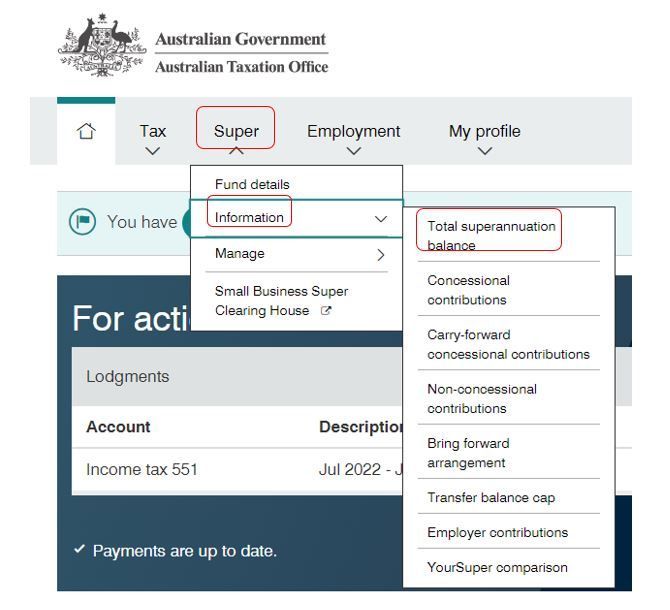
The second way to check your TSB is by logging into your myGov account which will show your TSB for the previous 30 June as well as other helpful information, such as your:

·        Eligibility to use the NCC (after-tax contribution) bring forward arrangement

·        Concessional contribution cap

·        Unused carry forward concessional contribution cap amounts that have accrued since 1 July 2018

·        Employer contributions, and more.


Checking this information can be beneficial before you make any further contributions prior to 30 June 2024 as it can help you avoid exceeding your contribution caps.


***see image above


The following steps should be taken to track your TSB (and other related superannuation information):

1.      Log into your myGov account by visiting my.gov.au. If you don’t have a myGov account you can create an account. Alternatively, if you have a myGov account but have not linked the ATO service to it, you can also link it here too.

2.      Select the super tab, then click on the information option and then click on ‘total superannuation balance’ (as shown in the image below). Here you will be able to see your current TSB as recorded by the ATO.

3.      You will be able to see your current TSB for each superannuation interest you hold, including your prior year’s 30 June TSB under the ‘History’ button.


Tip – check the information provided

You should take care when checking your TSB and other amounts displayed in myGov, as depending on the type of superannuation fund you have, your 30 June balance and contribution details may not have been reported to the ATO yet.


For example, SMSFs are not required to report their superannuation information to the ATO as regularly as large APRA-regulated funds so your contributions and your account balance may not be up to date in myGov. This is because the ATO obtains information about SMSFs from the annual return each year. This means any SMSF members will need to check their SMSF records to track their TSB and contribution caps if this information is not up to date in their myGov account.


Need help?

Please contact us if you need more information on how to check your TSB or if you require further information about your superannuation account.


Previous Blog Posts:

By Brad Dickfos January 27, 2026
This article focuses on self-employed clients. If you’re a salary earner or retiree, you might find one of our other blogs more helpful. 
By Brad Dickfos January 9, 2026
There is much in the media about how the 50% capital gains tax (CGT) discount has contributed to the housing affordability problem in Australia (although no doubt the problem is a lot more complex than attributing it mainly to any taxation measure or measures).
By Brad Dickfos December 18, 2025
Most of us keep a close eye on our bank accounts. But superannuation can be easier to lose track of, especially if you’ve changed jobs, moved house, changed your name, or simply set up a new fund and assumed everything followed you. That’s why the Australian Taxation Office (ATO) has issued a timely reminder. There is now $18.9 billion in lost and unclaimed super sitting across Australia. That’s up $1.1 billion since 2024 and spread across just under 7.3 million accounts. In other words, a lot of Australians have retirement savings that aren’t currently working for them and some of it could be yours. What “lost” or “unclaimed” super actually means Super doesn’t vanish, but it can go missing from your radar. It typically happens when an account becomes inactive and your super fund can’t contact you, or when you end up with multiple funds over the years. The ATO also holds certain amounts of super on behalf of individuals, for example, small inactive balances that have been transferred to the ATO, or other unclaimed amounts. The average amount of lost or unclaimed super is around $2,590 per person. That might not sound life-changing today, but over time it can grow into tens of thousands by retirement. A special note if you have an SMSF If you have an SMSF, this ATO update is particularly worth paying attention to. When you established your SMSF, you might have transferred most of your super across, but kept some behind, for example, to retain insurance cover through another fund. That means there could still be older super accounts from past jobs or retail/industry funds sitting in your name. The ATO is urging SMSF members to do a check, because a share of the $18.9 billion in lost and unclaimed super might be yours and could be rolled into your SMSF. One important practical tip is that if you locate lost super and want to move it into your SMSF, but your SMSF doesn’t show up as a transfer option in ATO online services, it’s often due to the fund’s compliance status. Take a moment to confirm your SMSF is listed as “complying” or “registered” on Super Fund Lookup. How to check for lost super (it only takes minutes) The ATO has made this super simple (pun intended!). You can: 1. Log in to myGov and go to ATO online services 2. Navigate to the Super section to view: Super held by the ATO Any lost or unclaimed accounts 3. Request a transfer to an eligible super account. Even if you don’t find anything, you’ll at least know everything is where it should be. Simple habits that help you stay on top of super Finding lost super is great but preventing it from happening at all is even better. A few easy habits can make a big difference: Keep your details up to date with your fund and the ATO so you stay contactable. Check whether you’ve got more than one account. Multiple accounts can mean multiple fees and duplicated insurance Consider consolidating if it suits your situation. Fewer accounts can mean lower fees and easier management but just be sure to check any insurance you might lose before rolling over Read your annual statement. It’s a quick way to confirm contributions, fees, returns, investment mix and beneficiaries. Why acting now matters Since 2022, the ATO has already reunited Australians with about $5.5 billion in previously unclaimed super. But there’s still nearly $19 billion waiting to be found. A few minutes today could translate into a healthier retirement balance later. It’s easy to put super in the “deal with it later” basket, but it’s still your hard-earned money. If you want a hand finding lost super, combining accounts, or moving money into your SMSF, reach out to us. We can guide you through the steps and make sure you’re able to claim any lost super without any hassles.