SMSFs Borrowing to Invest

Brad Dickfos • May 21, 2022

SMSFs Borrowing to Invest


Thinking about using your SMSF to borrow to invest? SMSF borrowing has become a popular way of maximising retirement savings because it allows you to increase the amount available to invest within your SMSF. 


SMSFs are generally not allowed to borrow money. However there are some limited exceptions including borrowing to invest under a specific type of borrowing arrangement called a ‘limited recourse borrowing arrangement’ (LRBA).


What is an LRBA?


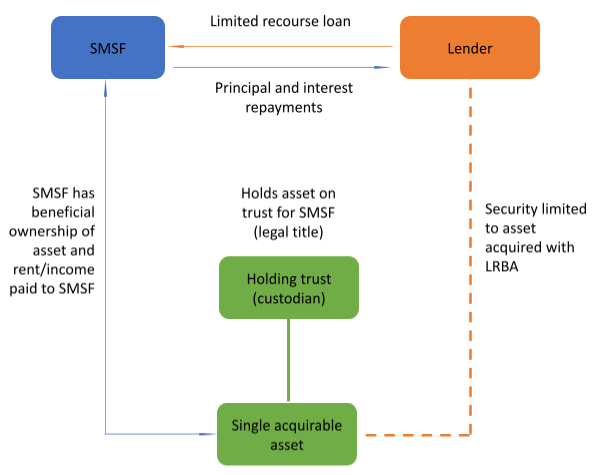
An LRBA is a type of loan structure designed for SMSFs that involves establishing a ‘holding trust’ (also called a ‘bare trust’) where the trustee of this trust (also known as the custodian) legally holds the asset on behalf of the SMSF trustee/director. 


The borrowing must be on a ‘limited recourse’ basis for the purpose of acquiring an asset that is held on trust until the borrowing has been repaid. This means the lender’s recourse is limited to the asset being bought under the arrangement. For example, if your SMSF is unable to meet its loan obligations, the bank can only access the asset that was purchased using the loan (ie, the bank cannot take other assets of the fund). 


However, to protect themselves from this happening, most banks require you to provide a personal guarantee for the loan so that in the event of a default, the bank would seize your personal assets given that they can’t access your SMSF assets. This potential personal exposure should be factored in when contemplating entering into an LRBA.


The Holding Trust


As mentioned above, a LRBA involves establishing a ‘holding trust’ for the sole purpose of legally holding the asset on behalf of the SMSF for the duration of the loan. This holding trust arrangement recognises that the asset is to be held by the trust until the debt is repaid, at which point legal ownership can pass to the SMSF.


The asset that is held on trust for the SMSF must be an asset that the SMSF would be permitted to invest in directly. In most cases, an LRBA is used to purchase real property. However, it may also be possible to purchase a parcel of shares in the same company or units in a managed fund using an LRBA, subject to certain conditions being met. 


The diagram below illustrates the structure of a typical LRBA.


Once the loan has been repaid, the arrangement can then be unwound and legal title to the asset transferred to the SMSF or the holding trust can continue to hold the asset.


The Pros


  • Using a LRBA can allow your SMSF to purchase an asset (ie, property) which may otherwise be out of reach were the SMSF not to borrow.


  • Your SMSF will receive all of the income and deductions, without having to fund the entire purchase price upfront.


  • Growth of the asset occurs in the concessionally taxed superannuation environment. That is, superannuation funds pay tax at a maximum rate of 15% and the rate of tax on capital gains where an asset is held for more than 12 months effectively reduces to 10% on the ultimate disposal of the asset. Further, if the asset is a segregated pension asset and fully supports a retirement phase pension interest at the time of disposal, capital gains tax may not be payable at all.


  • SMSF members can make contributions to superannuation, including tax deductible contributions, in order to pay down the LRBA.


The Cons


  • Potential personal exposure in the event of a loan default by the SMSF (see earlier).


  • LRBAs are complex as certain conditions must be met in order for the LRBA to comply with superannuation law. This means advice from qualified professionals is needed to set them up which can increase the set up costs when compared to borrowing outside of the superannuation environment. 


  • Potential stamp duty costs and implications can arise from setting up the LRBA structure. 


  • If the strict requirements of the LRBA rules are not met, the fund will be in breach of the superannuation law which could result in severe penalties for your SMSF.


  • An LRBA can only be used to purchase a ‘single acquirable asset’, which can be quite restrictive. 


  • Although gearing can deliver benefits when the capital value of the investment increases, gearing can also magnify losses if the capital value of the investment falls. Thus, the profitability of a gearing strategy depends on the income and capital growth of the proposed investment being greater than the borrowing and ongoing costs.


  • Potential illiquidity risk – if the asset acquired represents a large portion of the SMSF's total assets and the asset cannot be sold quickly in order for the SMSF to meet its obligations, the SMSF may need to sell the asset at an inappropriate time, such as when it is valued at less than the amount outstanding on the loan.


  • If the asset is property:


  • There is a potential risk that tenants are unable to pay rent, or the property is not rented. 
  • There are restrictions on the type of work that can be carried out on a property while the LRBA is still in place. This is because SMSFs cannot significantly change the character of the property while it is subject to borrowing. For example, a vacant block of land could not be built on, nor subdivided, while the loan is still in place.


  • The outstanding balance of the LRBA entered into from 1 July 2018 is included in your total superannuation balance if:


  • You satisfy a condition of release that allows you full access to your superannuation (ie, such as retirement, terminal illness, permanent incapacity and reaching age 65), or 
  • The loan is provided by an associate, which includes members of the SMSF, relatives and related entities (such as companies and trusts).


As can be seen, there are a number of rules to follow so it is crucial you seek specialist advice to determine whether LRBAs are right for your SMSF. 


This information is general in nature. It has been prepared without taking into account your objectives, personal or business circumstances, financial situation or needs. Because of this, you should, before acting on this information, consider in consultation with your adviser, its appropriateness, having regard to your objectives, personal or business circumstances, financial situation and needs.

By Brad Dickfos December 9, 2025
Sometimes it can be, but only in limited circumstances. The tax deductibility of expenditure on clothing is subject to strict ATO guidelines. These cover occupation-specific clothing, compulsory or registered non-compulsory uniforms and protective items. Conventional clothing What you can’t claim is the cost of conventional clothing, even where your employer expects you to observe a particular dress style. You might work in an office environment, and your employer expects you to wear a business suit to work, even though you wouldn’t have even bought the suit but for your employer’s dress requirements. While the cost of the suit might seem like a work related expense, it is not deductible as it is conventional clothing that could also be worn outside of work. This makes it a private expense, even though it relates directly to your employment. Conventional clothing includes business attire, non-monogrammed black trousers and white shirts worn by wait staff, non-protective jeans and drill shirts worn by tradies and athletic clothes and shoes worn by PE teachers. Occupation-specific clothing On the other hand, occupation-specific clothing falls on the deductible side of the line, for example a chef’s distinctive chequered pants or a health worker’s blue uniform, including nurses’ stockings and non-slip shoes. Compulsory uniforms The cost of clothing that forms part of a compulsory uniform is generally deductible. A compulsory uniform is a set of clothing that identifies you as an employee of a particular organisation. Your employer must make it compulsory to wear the uniform and have a strictly enforced workplace policy in place. You can only claim a deduction for shoes, socks and stockings if: They are an essential part of a distinctive compulsory uniform, and The characteristics (the colour, style and type) are an integral and distinctive part of your uniform that your employer specifies in the uniform policy, for example, airline cabin crew members. You can claim for a single item of clothing such as a jumper if it's distinctive and compulsory for you to wear it at work. An item of clothing is unique and distinctive if it: Has been designed and made only for the employer, and Has the employer's logo permanently attached and is not available to the public. Just wearing a jumper of a particular colour is not part of a compulsory uniform, even if your employer requires you to wear it, or you pin a badge to it. Non-compulsory uniforms You can only claim for non-compulsory work uniforms if your employer has registered the design with AusIndustry. This means the uniform has to be on the Register of Approved Occupational Clothing. Your employer will be able to clarify whether your uniform is registered. Protective clothing The cost of protective clothing is deductible, and covers such items as: Fire-resistant clothing Sun protection clothing with a UPF sun protection rating Hi-viz vests Non-slip nurse’s shoes Protective boots, such as steel-capped boots or rubber boots for concreters Gloves and heavy-duty shirts and trousers Occupational heavy duty wet-weather gear Boiler suits, overalls, smocks or aprons you wear to avoid damaging or soiling your ordinary clothes during your work activities. Laundry and dry-cleaning costs and repairs You are entitled to a deduction for the cost of cleaning your deductible clothing. If you launder them at home, the Tax Office will allow you a deduction of $1 per load where the load contains only deductible clothing, or 50 cents per load where deductible clothing is mixed with other items. You are entitled to claim the cost of dry-cleaning deductible clothing, as well as the cost of mending and repairs. Record keeping You should keep receipts or other documentary evidence of your expenditure on buying, laundering or repairing deductible work clothing. Proof of laundering clothing at home can be in the form of diary entries. Allowances If your employer pays you a clothing allowance, this needs to be included in your assessable income, and you can only claim what you have actually spent. Feel free to come and see us for advice as to whether your expenditure on work clothing is deductible.
By Brad Dickfos December 1, 2025
Big news for anyone with a large super balance – the government has gone back to the drawing board on the controversial Division 296 tax , and the changes are a big step toward fairness and common sense. A quick recap When the Division 296 tax was first announced in 2023, it caused an uproar. The main problem? It would have taxed unrealised gains, that is, paper profits you haven’t actually made yet and set a $3 million threshold that wasn’t indexed meaning it wouldn’t rise with inflation. After a wave of feedback from the industry, the government has listened. The Treasurer’s new announcement, made in October 2025, fixes some of the biggest issues. The revamped version is designed to be fairer, simpler, and more in line with how tax usually works. The plan is to start the new system from 1 July 2026, with the first tax bills expected in 2027–28. What’s changing Here’s what’s new under the revised Division 296 tax: · Only real earnings will be taxed. No more tax on unrealised gains as you’ll only pay on earnings you’ve actually made. · Super funds will work out members’ real earnings and report this to the ATO. · The $3 million threshold will be indexed to inflation in $150,000 increments, keeping pace with rising costs. · A new $10 million threshold will be introduced. Earnings above that will be taxed at a higher rate of 40%, and that threshold will also rise with inflation. · The start date is pushed back to 1 July 2026, giving everyone more time to prepare. · Defined benefit pensions are included, so all types of super funds are treated the same. So what does this mean in practice? Think of it as a tiered tax system: · Up to $3 million – normal super tax of 15%. · Between $3 million and $10 million – taxed at 30%. · Over $10 million – taxed at 40%. Basically, the more you have in super, the higher the tax rate on your earnings above those thresholds. How it will work Super funds will continue reporting members’ balances to the ATO, which will figure out who’s over the $3 million mark. If you are, your fund will tell the ATO your actual earnings (not paper gains). The ATO will then calculate how much extra tax you owe. We don’t yet have the fine print on what exactly counts as “realised earnings,” but it’s likely to mean profits you’ve actually made, similar to how taxable income is treated now. What’s still up in the air While these updates make the system much fairer, there are still a few unanswered questions: · What exactly counts as “earnings”? Will it only include profits made after 1 July 2026, or could older gains that are sold later be included too? · What happens with capital gains? Super funds usually get a one-third discount on capital gains for assets held over a year, but it’s unclear whether that will still apply. · How will pension-phase income be handled? Some super income is tax-free when you’re in the pension phase, and we don’t yet know how that will interact with the new rules. · Can people with over $10 million move money out? If your earnings above $10 million are taxed at 40%, you might want to shift funds elsewhere but the government hasn’t said if that’ll be allowed. What it means for you If your super balance is over $10 million, the proposed rules mean that a portion of your superannuation earnings could attract a higher tax rate of up to 40%. For people with between $3 million and $10 million, the new system could also change how much tax applies to their super earnings, depending on how the final legislation defines “realised gains.”  But don’t rush. These rules aren’t law yet, and if you take your super out, it’s hard to put it back because of contribution limits. It’s best to wait for the final legislation and get professional advice before making any decision to withdraw benefits from super.
By Brad Dickfos November 18, 2025
( ) Knowing the rules around Fringe Benefits Tax (FBT), GST credits and what is or isn’t tax deductible can help keep tax costs to a minimum. Holiday celebrations generally take the form of Christmas parties and/or gift giving. (<->)