
Take care with contribution timing this financial year
Brad Dickfos • June 19, 2024

Are you are planning to maximise your superannuation contribution caps this financial year? If so, it’s crucial to get the timing right so your contribution is received by your superannuation fund in the current financial year.


Lessons from a recent court case

A recent court case[1] has confirmed that contributions are made on the date they are received by a member’s superannuation fund, not when they are made. The member in this case had intended that his contributions be attributed in the year the payments were made (ie, in late June) rather than on the dates they were received (ie, in early July).


However the ATO and the Administrative Appeals Tribunal ruled that the contributions were made on the dates the funds were received by his superannuation fund, rather than the date of payment initiation. This meant that the member’s contributions were deemed to be made in the next financial year which placed the transactions into the next financial year with other contributions the member made that year, causing the member to exceed his contribution caps.


The ATO view on when a contribution is made

The timing of when a contribution is made is important for a number of reasons, particularly when this occurs close to 30 June. For example, the timing can impact when the contribution will count towards your contribution caps, whether your fund is able to accept your contribution(s) or whether a tax deduction may be claimed for your contribution(s).


The ATO’s Taxation Ruling[2] on superannuation contributions confirms that a contribution is made when the capital of the fund is increased. This occurs when an amount is received, or ownership of an asset is obtained, or a fund otherwise obtains the benefit of an amount.


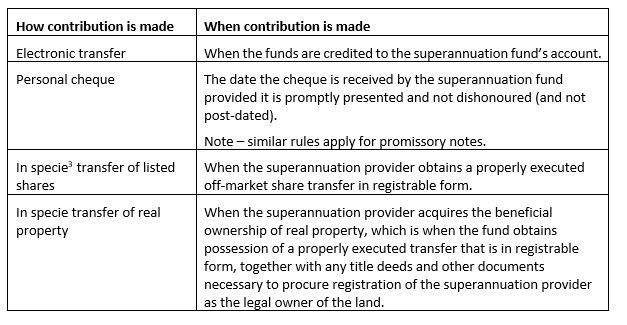
For example, a contribution of money via an electronic transfer is made when the amount is credited to your superannuation fund’s bank account, not when you press the button to effect the payment.


The above table summarises some of the common ways in which funds are transferred and when the contribution is deemed to be made. Please note this list is not exhaustive.


Timing is key

This year 30 June falls on a Sunday (a non-business day), so leaving it to the last minute and making a contribution over the weekend may not provide enough time for your contribution to reach your superannuation fund as transfers typically happen on business days.


If you are a member of a large APRA-regulated superannuation fund, make sure you know when the cut-off day is as this is the date your fund will accept contributions so that they will be allocated in that same financial year. Otherwise, there is no guarantee that contributions received after this date will be allocated before the end of the financial year. In the end, a contribution received by your fund on 1 July 2024 is a contribution that will be treated as belonging to the 2024-25 financial year.


On the other hand, if you have an SMSF, electronic transfers between accounts with the same bank generally happen immediately which means contributions will be made instantaneously and therefore count towards your contribution caps this financial year. This can be helpful if you end up making contributions last minute. However, a transfer between different banks is likely to take longer to clear which could see your SMSF receiving the transfer of funds after it was initiated by you as the contributor.


Superannuation clearing house delays

You should also take extra care if your employer makes contributions to your fund by using a superannuation clearing house as there can be a time delay from when your employer’s payment is made to the clearing house and when your superannuation fund receives the contribution. This is because contributions made by employers to a clearing house generally do not constitute the receipt of a contribution by a superannuation fund as a contribution cannot be recorded by the superannuation fund until it is received. This could see last minute 2023-24 superannuation contributions by employers not reach their employee’s fund in time to be recorded as a contribution in 2023-24 and may end up being recorded in the 2024-25 financial year. This could cause you to exceed your concessional contribution cap if you are also planning on making a personal superannuation contribution and claiming the amount as a tax deduction.


Key takeaway

The bottom line is to allow plenty of time to make your superannuation contributions well before 30 June in order for your contribution to be received by your superannuation fund this financial year because in the end, a contribution is deemed to be made at the time it is received by your superannuation fund, not when you process the transaction. 


[1] Mackie v Commissioner of Taxation [2024] AATA 619, 3 April 2024.

[2] Taxation Ruling TR 2010/1.

By Brad Dickfos December 9, 2025
Sometimes it can be, but only in limited circumstances. The tax deductibility of expenditure on clothing is subject to strict ATO guidelines. These cover occupation-specific clothing, compulsory or registered non-compulsory uniforms and protective items. Conventional clothing What you can’t claim is the cost of conventional clothing, even where your employer expects you to observe a particular dress style. You might work in an office environment, and your employer expects you to wear a business suit to work, even though you wouldn’t have even bought the suit but for your employer’s dress requirements. While the cost of the suit might seem like a work related expense, it is not deductible as it is conventional clothing that could also be worn outside of work. This makes it a private expense, even though it relates directly to your employment. Conventional clothing includes business attire, non-monogrammed black trousers and white shirts worn by wait staff, non-protective jeans and drill shirts worn by tradies and athletic clothes and shoes worn by PE teachers. Occupation-specific clothing On the other hand, occupation-specific clothing falls on the deductible side of the line, for example a chef’s distinctive chequered pants or a health worker’s blue uniform, including nurses’ stockings and non-slip shoes. Compulsory uniforms The cost of clothing that forms part of a compulsory uniform is generally deductible. A compulsory uniform is a set of clothing that identifies you as an employee of a particular organisation. Your employer must make it compulsory to wear the uniform and have a strictly enforced workplace policy in place. You can only claim a deduction for shoes, socks and stockings if: They are an essential part of a distinctive compulsory uniform, and The characteristics (the colour, style and type) are an integral and distinctive part of your uniform that your employer specifies in the uniform policy, for example, airline cabin crew members. You can claim for a single item of clothing such as a jumper if it's distinctive and compulsory for you to wear it at work. An item of clothing is unique and distinctive if it: Has been designed and made only for the employer, and Has the employer's logo permanently attached and is not available to the public. Just wearing a jumper of a particular colour is not part of a compulsory uniform, even if your employer requires you to wear it, or you pin a badge to it. Non-compulsory uniforms You can only claim for non-compulsory work uniforms if your employer has registered the design with AusIndustry. This means the uniform has to be on the Register of Approved Occupational Clothing. Your employer will be able to clarify whether your uniform is registered. Protective clothing The cost of protective clothing is deductible, and covers such items as: Fire-resistant clothing Sun protection clothing with a UPF sun protection rating Hi-viz vests Non-slip nurse’s shoes Protective boots, such as steel-capped boots or rubber boots for concreters Gloves and heavy-duty shirts and trousers Occupational heavy duty wet-weather gear Boiler suits, overalls, smocks or aprons you wear to avoid damaging or soiling your ordinary clothes during your work activities. Laundry and dry-cleaning costs and repairs You are entitled to a deduction for the cost of cleaning your deductible clothing. If you launder them at home, the Tax Office will allow you a deduction of $1 per load where the load contains only deductible clothing, or 50 cents per load where deductible clothing is mixed with other items. You are entitled to claim the cost of dry-cleaning deductible clothing, as well as the cost of mending and repairs. Record keeping You should keep receipts or other documentary evidence of your expenditure on buying, laundering or repairing deductible work clothing. Proof of laundering clothing at home can be in the form of diary entries. Allowances If your employer pays you a clothing allowance, this needs to be included in your assessable income, and you can only claim what you have actually spent. Feel free to come and see us for advice as to whether your expenditure on work clothing is deductible.
By Brad Dickfos December 1, 2025
Big news for anyone with a large super balance – the government has gone back to the drawing board on the controversial Division 296 tax , and the changes are a big step toward fairness and common sense. A quick recap When the Division 296 tax was first announced in 2023, it caused an uproar. The main problem? It would have taxed unrealised gains, that is, paper profits you haven’t actually made yet and set a $3 million threshold that wasn’t indexed meaning it wouldn’t rise with inflation. After a wave of feedback from the industry, the government has listened. The Treasurer’s new announcement, made in October 2025, fixes some of the biggest issues. The revamped version is designed to be fairer, simpler, and more in line with how tax usually works. The plan is to start the new system from 1 July 2026, with the first tax bills expected in 2027–28. What’s changing Here’s what’s new under the revised Division 296 tax: · Only real earnings will be taxed. No more tax on unrealised gains as you’ll only pay on earnings you’ve actually made. · Super funds will work out members’ real earnings and report this to the ATO. · The $3 million threshold will be indexed to inflation in $150,000 increments, keeping pace with rising costs. · A new $10 million threshold will be introduced. Earnings above that will be taxed at a higher rate of 40%, and that threshold will also rise with inflation. · The start date is pushed back to 1 July 2026, giving everyone more time to prepare. · Defined benefit pensions are included, so all types of super funds are treated the same. So what does this mean in practice? Think of it as a tiered tax system: · Up to $3 million – normal super tax of 15%. · Between $3 million and $10 million – taxed at 30%. · Over $10 million – taxed at 40%. Basically, the more you have in super, the higher the tax rate on your earnings above those thresholds. How it will work Super funds will continue reporting members’ balances to the ATO, which will figure out who’s over the $3 million mark. If you are, your fund will tell the ATO your actual earnings (not paper gains). The ATO will then calculate how much extra tax you owe. We don’t yet have the fine print on what exactly counts as “realised earnings,” but it’s likely to mean profits you’ve actually made, similar to how taxable income is treated now. What’s still up in the air While these updates make the system much fairer, there are still a few unanswered questions: · What exactly counts as “earnings”? Will it only include profits made after 1 July 2026, or could older gains that are sold later be included too? · What happens with capital gains? Super funds usually get a one-third discount on capital gains for assets held over a year, but it’s unclear whether that will still apply. · How will pension-phase income be handled? Some super income is tax-free when you’re in the pension phase, and we don’t yet know how that will interact with the new rules. · Can people with over $10 million move money out? If your earnings above $10 million are taxed at 40%, you might want to shift funds elsewhere but the government hasn’t said if that’ll be allowed. What it means for you If your super balance is over $10 million, the proposed rules mean that a portion of your superannuation earnings could attract a higher tax rate of up to 40%. For people with between $3 million and $10 million, the new system could also change how much tax applies to their super earnings, depending on how the final legislation defines “realised gains.”  But don’t rush. These rules aren’t law yet, and if you take your super out, it’s hard to put it back because of contribution limits. It’s best to wait for the final legislation and get professional advice before making any decision to withdraw benefits from super.
By Brad Dickfos November 18, 2025
( ) Knowing the rules around Fringe Benefits Tax (FBT), GST credits and what is or isn’t tax deductible can help keep tax costs to a minimum. Holiday celebrations generally take the form of Christmas parties and/or gift giving. (<->)